‘Mad’ monarchs have always been studied as fascinating case studies on the treatment of pre-literate societies mentally ill, because their lives are so well documented in comparison with the rest of the population. They serve as a statistically anomalous microcosm for the history of psychology, and an endless source of debate. Were they truly ‘mad’ due to a medical phenomenon rooted in genetic predisposition – and the royal penchant for diplomatic inbreeding – significantly boosting the likelihood and frequency of psychiatric illness within these powerful families? Or did the inordinate, god-given power itself drive the royals of the past to madness? Alternatively, were rumours of insanity simply exacerbated to serve a political aim, and passed down in written record?
One of the most notorious and controversial of these monarchs is perhaps Joanna (Juana) of Castile, also known simply as ‘Joanna the mad.’
Joanna was born in 1479 to Isabella I of Castile and Ferdinand II of Aragon; regions which were then separate kingdoms constituting modern day Spain. She was known to be a beautiful and highly educated woman, headstrong enough even to display scepticism regarding her families stringent (and frankly, genocidal) Catholic faith. According to letters from Ferdinand’s own attendants, her blasphemous and unorthodox worldly thinking allegedly resulted in her own mother using torture methods to admonish her, including dangling her by ropes with weights around her ankles. If this is infact true, and not salacious court gossip spread by the kings men to ridicule his wife or to justify claims of Joanna’s instability later in life, this is a form of cruelty and abuse that would certainly inflict trauma onto the psyche.
Joanna herself was never expected to be monarch of either Castile or Aragon, with as many individuals standing between her and the throne as there are preventing Prince Harry from becoming King today. However, she was thrust very suddenly into power by a string of human tragedies within her immediate family. Her elder brother Juan died at the age of 19, leaving behind his pregnant wife Margaret of Austria, who sadly miscarried his only heir. Joanna’s remaining older sibling Isabella died a year later following the traumatic birth of her son Miguel, who then passed away at only one year of age. This rendered Joanna Princess of Asturias (heir to the throne of Aragon) up until her mothers death in 1504, making her queen of Castile.
Joanna was not to rule alone. In fact, on a technicality known as ‘not having a penis’, she could inherit the royal title of heir but could not inherit her mothers estate without a husband to serve as its executor. At 17 years old in 1496, she was married to Philip I the Handsome – Archduke of Hapsburg – which was deemed a fortunate pairing due to the fact that he was only a year older than her and renowned for his good looks. Joanna is believed to have adored Philip intensely, and behaved possessively toward him as a result, despite this being improper for a lady at this time. Over their decade long marriage, she bore him 6 children. Eleanor in 1498, Charles (more on him later) in 1500, Isabella in 1501, Ferdinand in 1503, Mary in 1505 and Catherine in 1507. But, despite her sex, Joanna was Queen and Philip merely her consort; creating a power imbalance between them which opposed traditional gender roles and may have served as a motive for Philip to have her removed from power, by cultivating rich claims of madness.
Philip didn’t waste much time in declaring himself the true King. He made his way to Madrid with Joanna, seizing lands and revenues with the support of an army of 2000 German mercenaries provided by his father Maximilian, the Holy Roman Emperor. He also had coins minted depicting their faces side by side as co-rulers. While Joana had some support among the people, her political supporters were soon offput by her attempts to protest her husbands flagrant theft of her title and power, as she refused to attend any events acknowledging his claim, or to wear anything but black when she did appear publicly. Thus, her rightful crown was effectively seized.
Philip was not the only influential man at this time insistent on convincing the public that Joanna was crazy, either. Despite his letters appearing to protest against Philip ‘depriving Joan of liberties’, her father Ferdinand started undermining her almost as soon as she was crowned. He produced the reports sent from Burgundy alleging that she was mad and unfit for ruling, and ultimately had the Spanish Courts declare him custodian of Castile, while his bishops attempted to convince Joanna to make him regent over the kingdom. He, also, minted coins depicting himself as Joanna’s co-ruler. Philip told Joanna of her fathers betrayal, but with no evidence of this – and a mountain of evidence that Philip himself was doing the very same thing – she refused to be swayed. So to prevent her from taking the side of her father, her beloved husband committed the ultimate betrayal and had her locked away.
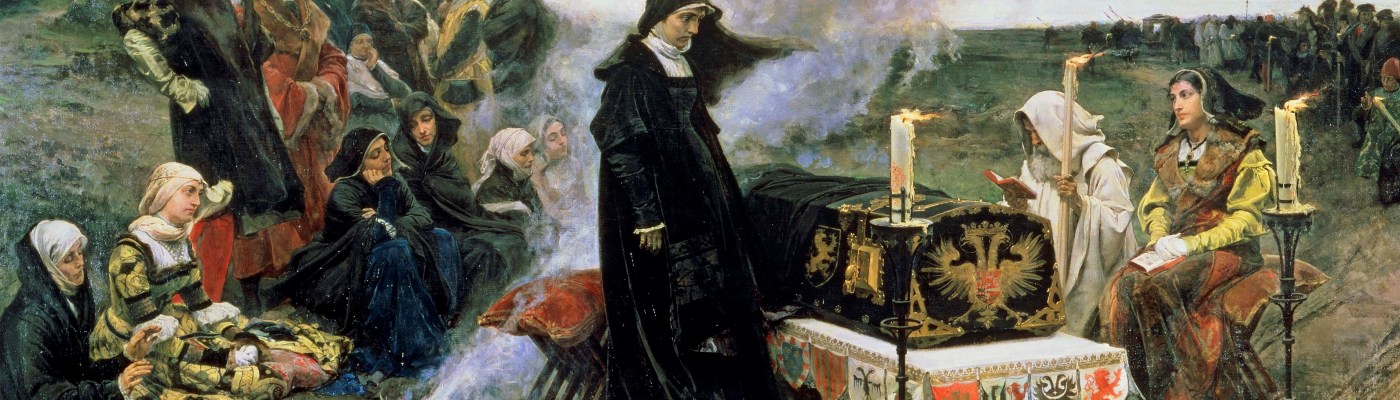
Philip only got to enjoy his regency for 6 months, though, before his death. At this time, Joanna regained some agency and in a calculated move to perhaps postpone inevitable demands to remarry and surrender her newly reacquired holdings to yet another would-be king, she entered a long period of mourning. Joanna toured the countryside with her husbands casket for many months, and though historians now believe she may have been buying herself time by refusing to bury Philip, reports from this period indicate that the pregnant queen was so bereaved that she had lost her senses and was acting not out of logic, but unhinged emotion.

Ferdinand did not wait long to usurp her when she became vulnerable once more, upon Philip’s burial and the subsequent birth of their final baby. He had his daughter again declared unfit and forced under house arrest in the Palace of Tordesillas in 1507, where she was deliberately kept out of the loop on events outside the walls of the convent where she spent her days, and provided no means of outside communication by which to clear her name.
Upon Ferdinand’s death, Charles – firstborn son of Joanna and Philip – inherited the throne of Aragon from his grandfather, but could not legally take control over Castile whilst his mother lived. So, he ruled as her regent by keeping her confined away, serving as jailor to his own mother in a bid to usurp her power. He maintained relations with her by coming up with increasingly elaborate excuses to maintain her seclusion for her own wellbeing, such as avoiding an outbreak of plague. He even allegedly had fake funeral processions walk past the castle several times a day to reinforce this falsehood and instil fear within her, making her easier to placate. Her jailor in his absence was the Marquis of Denia, to whom the palace belonged, and who’s letters make up the majority of our testimony as to how she lived henceforth. This entire chapter of Joanna’s life constitutes one of the most intense cases of gaslighting I’ve ever had the displeasure of reading about.
With the context in place, I will now explain some of the central ‘evidence’ for Joanna suffering from a mental illness, either throughout or towards the end of her life. However, please keep in mind that the sources for much of this information are the three people who would have most stood to gain from dethroning her; her husband who would have become king-regent were she proven unfit to rule, her own son Charles who ultimately succeeded her as King and then as Holy Roman Emperor, and her father; who also sought to produce his own male heir to rule in her place, rather than see the throne of Aragon pass to a woman upon his death. I will therefore preface with one big “allegedly“.
- Neuroticism. Throughout their marriage, Philip was rarely ever faithful, and Joanna did not turn a blind eye to this infidelity. Instead she became furiously jealous and would fly at her husband in anger, both publicly and privately. Upon discovering one of Philip’s mistresses was an attractive lady of the court, she went so far as to attack the woman violently, hacking off all of her hair before stabbing her in the face with the scissors. Subsequently, Philip would avoid his wife, causing her to pace the halls of her quarters wailing, sobbing and flinging herself against the walls for hours at a time.
- Mental breakdowns & schizophrenic symptoms. At various points throughout her life, Joanna was said to collapse mentally and emotionally, becoming irrational and unstable. One seemed to occur when her mother fell ill in 1504. Today, we perceive loss or illness of a loved one as a valid reason to fall into depression, though at this point in history ‘melancholia’ was not at all taken seriously and she would have been expected to function through it. Instead she refused to eat, and hardly slept. It was around this time that Philip abandoned his wife – pregnant with their daughter Mary – to flee the war and return to his home in Flanders. Desperate to follow him, Joanna visited her sick mother to request permission and was forbidden from going, instead facing confinement to her quarters. During this isolation she was reported to have displayed signs of schizophrenia; speaking to herself, wailing seemingly at nothing and continually banging on the walls as she sobbed, all while refusing food and hardly sleeping. She eventually gave birth in solitude, which may have exacerbated her condition through what we now view as post partum depression.
- Atypical behaviour. Despite all the pain that his abandonment and infidelity had caused her, Joanna was devastated when her beloved husband died of Typhoid fever in 1506 at only 28 years old. Heavily pregnant at the time with Catherine, she refused to relinquish Philip’s remains and kept his coffin close to her at all times. She travelled exceptional distances with it, kept it beside her bed, and even had it present while eating. Allegedly, she would open the coffin to kiss and embrace the body on some occasions. Whilst she was in mourning, her kingdom began to unravel around her. However, it is worth noting that this perhaps sensationalised story emerged after her father had his daughter confined to the palace once more and seized Castile from under her, leaving her absent and unable to defend herself. In fact, her own son Charles cruelly seized baby Catherine from her while she was confined. Taking away her only comfort, and last remnant of Philip, sent her into such a state of turmoil that she went on a hunger strike until her daughter was returned to her.
- Paranoia. Following Philip’s death, Joanna became obsessed with the notion that her husband had died of poisoning rather than Typhoid, an unfounded – but not entirely impossible – suggestion. For this she was labelled delusional. In response to her deteriorating mental state, her son Charles declared her unfit to rule, and took over from his mother as monarch in 1509. He had Joanna confined to a convent in Castile, where she remained until she died of natural causes in 1555. It is quite possible that this was to silence her, as she may have been onto something. However, during her time at the convent, she was said to act out against the nuns entrusted with her care, and make accusations that they had attempted to kill her in numerous increasingly unlikely ways. This lends credence to the idea that paranoia had seeped into Joanna’s mind and taken over. However, on the occasions that Joanna did beat her servants – which was not unusual at the time – she was still able to demonstrate self control when approached by the Marquis, suggesting that provocation may have been at play instead of the unbridled rage implied in his writings.
- Isolation. As I have described, Joanna was forcibly placed in what is essentially solitary confinement on several occasions to remove her from involving her unruly emotions in politics. This kind of isolation may have caused her mental state to deteriorate massively, most notably during her time at the convent, where Charles ordered that she be denied visits – even from immediate family – and that the nuns not speak to her at all. Joanna ultimately lived out the last 46 years of her life tragically alone, deprived of human interaction and with very little to mentally stimulate her. The Marquis wrote of her speaking of ending her own life, a symptom of major depression today, but with such circumstances considered this is hardly surprising.
- Genetics. Joanna had a colourful family history of mental illness, likely as a result of generational incest, although many of the specific illnesses I will mention have been posthumously diagnosed and are technically speculation. Her maternal grandmother Isabella of Portugal was declared mad with signs of schizophrenia, and sent to a convent. Her mother showed signs of instability and religious delusion in her torture of Joanna. Following Joanna’s death, her grandson Carlos and great-granddaughter Maria also ‘went mad’ with signs of depression and schizophrenia respectively.
If Joanna was biologically pre-disposed to mental illness, then her childhood of abuse, her long stream of bereavements, her husbands infidelity and her periods of extended confinement and isolation may have all served as environmental triggers pushing her towards a state of psychosis and instability. The tragic queen may have been a ticking time bomb by no fault of her own, which was activated by a lethal combination of mistreatment and the pressures of being flung into the centre of a power struggle between the most important men in her life.
However, for much of her time, she may have been no more ‘mad’ than the average person today who has been subject to abuse, coercive control, grief and loneliness. She may have been displaying expected responses to the tragedies in her life, which would render anyone unlikely to be a well adjusted and healthy adult. Tales of her talking to herself, showing paranoia, kissing a decaying corpse, sobbing uncontrollably for hours and using violence against attendants may have been exacerbated or even fabricated by the men in her life who saw her as a rung in their ladder to power. From a modern perspective, greater doubt can be cast on the legitimacy of their claims when considering additions in their accounts such as ‘speaking in tongues’, which is something based more strongly in biblical accounts of devils than it is in the DSM-5. With this said, though, it would be entirely understandable if by her arrival at the convent and towards the end of her life, Joanna had in fact been driven mad by her mistreatment, and her sense of learned helplessness as a woman who even as queen, was expected to step back and stay quiet for the comfort of men.
Regardless of whether she was or wasn’t ‘insane’, the sensational story of Queen Joanna is one of tragedy and misfortune. She has been immortalised as ‘Joanna the mad,’ rather than as a human being who endured great suffering, and was simply locked away rather than granted compassion or support. I think it would be kinder to remember her as a woman who spoke her mind when women were supposed to be seen and not heard, as a mother devoted to her children, and as a wife who loved somebody who could never love her more than he coveted her power.
 Behind The Mind